Showing posts with label devotions. Show all posts

Monday, March 02, 2009

Food Goes In Here


The Monster Machine and I were speaking briefly about Lenten practices, specifically about the "I'm giving up 'X'" bit.

His sense was that it is a bit disingenuous that we talk so much about what we're giving up. I think his exact words were, "They're all a bunch of phonies and I'd like to punch each and every one of them in the [redacted] mouth".

You're right. He is awful.

I, as you have no doubt come to learn, am far more gracious and understated.

Whatever.

There are as many understandings of fasting and prayer as there are people so it might be silly to say, "Isn't Lent supposed to be blah blah blargh?" but who am I to not be silly?

Right.

Let's assume that there is some sense of Lenten practice, fasting from some such or other, that is meant to convey an idea of anticipation and preparation for the celebration of Jesus' victory over the world, and an acknowledgment of the nature of that confrontation between Word and world wherein we're the buttholes* that want to destroy the Word. Let's say it's meant to remind us that the source of our hope is not in anything in the world save Jesus, and that is uniquely as God. It would seem the practice should be oriented about confronting us with that relation.

So... you don't eat perhaps with the the purpose of being confronted with hunger and that with the purpose of bringing to mind the idea that if you don't eat you'll die, and that perhaps brings to mind what you do to save yourself, only you remember you don't save yourself- even by eating, though eating seems like the very kind of thing that would save you because, if you remember, if you don't eat you'll die.

You might despair because you realize that the most seemingly fundamental and life-giving aspects of your existence are for nothing, so if it were up to you you'd be lost. Then perhaps ultimately this relation brings to mind hope and gratefulness because it's not up to you, at least as far as you're concerned as a Christian.

But face it, if you're an American, you're not likely famishing- pear-shaped softies that we are. We generally don't have the kind of relation to food that going without it is all that threatening. Moreover, as Christians (of a certain kind perhaps) we already know that we don't do anything to earn our salvation**. As good protestants, we know "we can't do anything to be saved". It is our mantra.

Except that we do- I mean we do have our "musts" for salvation. We must say the right things and think the right things. And saying and thinking are entirely matters of doing. They are a matter of our doing.

Tangentially, how convenient it is that we say "You could never feed enough hungry people to earn heaven so, though your master says to do it, don't bother except as an accessory," and then we follow that with "What you must do is think and speak 'thusly'". Perhaps "to what" or "for whom" that is convenient is a question we could sit with during Lent.

Back to our doing...

Isn't this doing our security? Rather than food, perhaps it is this foundational Protestant "doing" from which we must rest. Could you stop reading your Bible for forty days? Could you stop gathering with like-minded folks to sing and hear about God's grandiosity these few Sundays? Could you not preach? Attend Sunday School? Teach a Bible study?

No? If you don't do it you'll die?

---

*I use the word "buttholes" in this. Don't read it if this scandalizes your sensibilities. -OR-
Fast from your sensibilities.

**This is just a variation on the theme you likely know- some form of "you can't earn your salvation" "you can't do anything to warrant God's grace"...

Tuesday, October 28, 2008

My Dogs Don't Speak English


Suppose, just for the sake of argument, we had a sense of salvation that said we were freed from guilt and that means we were well-adjusted, self-actualized, happy, positive people who have no reason to feel bad or unduly suffer.

Let's say that's what we say Jesus does for one who is saved, so I am saved from any sense of a negative self. So we have to assume that we believe in a self that can feel negative and so needs to be saved from that self-negativity. Fine, that comes with the territory- as do any number of other metaphysical assumptions and commitments. We're not evaluating or assessing the validity of those metaphysical assumptions- we're just imagining that that is what we say/believe.

So for the sake of time and space, let's say that what we say it means to be a Christian is to be redeemed from that negative sense of self so that what gives a life meaning is self-edifying fulfillment and happiness. Redemption is a matter of being able to love one's self.

So, if that were a description of some Christian person and that person hung out with others- though it would be odd to say that person was a part of a community... or maybe it would just be an odd community... anyway, it's some someones. You, and me, and some generic anyone. Okay. So it's some group of people like that- a church- how would that church confront things that were difficult to confront about themselves? I don't mean how would they deal with crises and difficulties. I mean how would they confront their ugliness, their participation in or affirmation of "bad things"? How would it even be possible?

ed.- Why do I hate grammar?

Wednesday, July 30, 2008

Do You Say This On Your Own, Or Do Others Say This About Me?


I, as I have learned any good parent should do, presumptuously think everyone wants to see pictures of my baby. As such I sent out a birth announcement (of sorts) to my department. Of course I attached a photo. Following that, more than one person has said she is the cutest baby they have ever seen. So cute, in fact, that she couldn't possibly be my child.

Two things about that:
1.) Most everyone says that about most people's babies without realizing that only one baby in the world could actually be the cutest baby they have ever seen. That's just the way the superlative form of an adjective works. So I understand that other people's comments about the cuteness of a baby, even my baby, must be understood in light of our general misuse of language.
2.) I think she is the cutest baby I have ever seen but also realize that personal commitment and passion color truth.

That said, a coworker of mine, apropos only to my sending out the email birth announcement, told me he thought of my baby while on his way to work one morning because of mention of a Beautiful Baby Contest on the radio. Well actually, it's on the internets but conducted by a radio station so he heard about it on the radio.

How's that for an unsolicited compliment, or better, window into THE TRUTH?

So I entered The Lovely Elizabeth into a baby contest. This is the picture I used.

It really is the greatest use of photographic technology ever.

Anybody that wanted to vote for her could. You would see she is contestant 46 in the D-F category. You would also see that Dylan is the new David.*

What could be more true than the results of a series of tubes contest judged by Tori Spelling and people who listen to Soft Adult Contemporary pop or respond to email forwards from family members telling them to vote for their baby?**

* That's just for the Ds. Overall, Jacob is actually the new Michael.
** That's just begging for a Venn diagram.

Thursday, July 24, 2008

That's A Lot To Load on a Baby


I once showed up at a Yearly Meeting meeting in a sport coat. I don't remember why. I wouldn't generally do that so there must have been some reason I was already wearing a sport coat or was going to need one later. I probably would not even remember that I wore a sport coat on that occasion except that someone older and more ministerially invested than I am said I was alienating people by wearing a sport coat. His take was that anyone interested in getting people into churches should notice and follow the cue that nobody in our culture wore sport coats or suits anymore.

He might be right. I hear someone in our Yearly Meeting/Annual Conference is doing some kind of Glamis or Dirt Bike church. On Sundays, he's going to meet with people who have opted to go dirt-biking for the weekend and then read the Bible and sing with them for a couple of hours.

I guess.

I suppose, it might look weird to show up to a place like that in a sport coat. The kind of weird monks probably seemed wearing habits, or the weird Quakers seemed wearing gray and dressed without ruffles. M'eh.

I suppose you can't argue with results. Here I am showing up to places in a sport coat, and there my accuser is, well-suited for ministry in our Yearly Meeting.

Nobody wears sport coats indeed.

Every now and then... well actually more often than "now and then" suggests...

So...

Quite frequently I hear about the need for THE CHURCH to be authentic and relevant. I mostly see that is meant in a Church Growth© way and not necessarily in a so the Kingdom of God is seen kind of way. How it manifests itself is in goatees, Hawaiian shirts as dressy, saying dude, kids who look and act like most everybody else but have NOTW branded somewhere on their person... I think it also makes us think we need to incorporate more images, the word "dude", faux-hawks, and flat screens... lots and lots of flat screens into our weekly concerts/affirmations. What's more relevant than that stuff?

The Lovely Elizabeth, like all babies, is as smart as they come. I don't mean she knows how to use a toilet or can make her hands do what she wants them to do. I don't even think she knows she can know it's possible to want at this point. So when I say smart I mean her world is infinite human possibility. She has the capacity to absorb and integrate herself into any mode of human existence that we know or can imagine. That's smart.

It's my job to narrow that. I will teach her that X is in a set with Y but not a part of the set that includes 1 and 2, and that's different from the set of ยต and ∆. I'll help set for her the frames of reference and categorization through which she will understand the world. My narrow world. It's my duty to shrink the horizon of her concerns and interests so that she may be well adjusted to one manner of being. It's my job to pass on my pettiness and sinful tendencies. My idols will become her idols so that for her- much of sin will merely be the way "it" is. If I do my job, I will have passed on the ability to overlook the worst of sins- that which justifies our way of being as the way of being.

When we talk about relevance or authenticity I don't think we want to mean we need to get at that but I suspect that's the very think we need to address if a church is really going to be relevant and authentic. I don't think we want to get at that because the very best idols are those to which we are the most loyal, those that offer the most security and comfort, those that let us skirt around the despair that blankets human existence.*

I'm sure at some point she'll lie. She'll steal. At some point she'll feel the pangs of guilt at hurting someone. We've got a world that understands sin as such and have great ways to alleviate that guilt. But there will be no need to feel guilty for participating in the world as it is- no need to recognize any of that as sin.

Unless the Holy Spirit does its** job. I'm looking forward to that. If it wasn't for that anticipation and action I don't know how that despair could be overcome... Well other than by embracing blissful ignorance or remaining in happy denial I wouldn't know how to do it. But it is there, and as I look at my daughter, the person that I call my daughter but know must be her own person, I am filled with a word I don't know in English. I have that waiting, expectant hope that is esperar.

Thank God.

* I'm really much more fun than this suggests.
** The Holy Spirit is an "it". Deal with it.

Tuesday, July 15, 2008

Sin Boldly


Working on my syllabus this morning I ended up with a preachy bee in my bonnet.

This was the buzz...
Can we as Christians say we proclaim the God of love if we cooperate with and legitimize institutional systems that by their very nature dominate and destroy?

Gee, that's a stupid question. Of course we can. We do it all the time, and it's not even a matter of of being duplicitous or hypocritical.*

Although it's an important question, it assumes one is willing to see their world as a part of that destructive machine. And who wants to do that?

A step must be made before that question can make sense. It's a step that requires the Word of God confronting us intensely in our humanness. The institutional systems of the above question are the perfect idols. They are a kind of perfect sin in that they can remain unexamined because they are often the very foundations of our world. In that they must be confronted, but in that, it's so easy to see them as separate from what we conventionally call sin. If we address them at all, they are often merely the unfortunate exigencies of our fallen world. It's the way it is may mean that these things are morally neutral or, if morally problematic, they are morally problematic in our favor.

In my metaphysical kookiness I say the Spirit confronts us concerning sin, but it's not the confrontation of asking what is correct; is it lawful to heal on the Sabbath or not?

If it is found with that question, it is in the silence of our response.

* Just blinded by the spirit of anti-christ.

Saturday, June 07, 2008

Where The Carcass is, The Buzzards Will Gather


I am not sympathetic to street preaching or cold sell evangelism. It is not, according to my understanding, a part of what it means to be making disciples. Though doing it may be a part of what it means for someone to be growing as a disciple. That's possible. Still, I just can't do it.

It is often dependent on facile word games or invalid and untenable premises. It sets up the Gospel as a matter of assent to an abstract proposition rather than living or virtue. It strikes me as arrogant and in line with the worst aspects of religious expression regardless of tradition.

That said, it is very straightforward and, in a sense, honest. So, it's got that going for it. If one believes that the only way a person can avoid an eternity of post-mortem torture and anguish is by giving assent to a certain proposition then the least one should do is tell as many people as they can how to avoid that torture. If you believe that the person ahead of you in line, your mother, the guy in the crosswalk, your coworker, et al. are bound to an eternity of inconceivable punishment if they do not hear about their sin and then accept Jesus Christ, then you would be a pretty big jerk if you didn't tell them all about that. It's not very different from standing idly by as a bus comes speeding down the highway and it is only a matter of moments before they are killed, but you say nothing. If you have the knowledge that can save them and you don't share it, then it seems like you have a part in their death. And we say hell would be worse than being hit by a bus.

It seems, someone that doesn't share this knowledge is far worse than the person who doesn't know any better. How could you not spend every waking moment warning people? How could you even sleep knowing hell was in store for everyone? How could anything not directly a warning about the coming hell not be a vanity? The least you would have to do is offer a warning if not a clear means of rescue.

It would seem a Christian who believes this but didn't share it would be the most detestable thing there could be.

I don't buy the premises though. Of course for some, these are not merely premises one can accept or not. These premises are, for some, "just the way things are" and I have clearly rejected that. My saying I do not buy the premises may simply be a result of cowardice and laziness. That may simply be how I reconcile my belief that I am a Christian with the fact that I do not go around telling everyone how to avoid spending eternity being boiled in a lake of fire. And, for others this may be the very point that shows I am not a Christian.

That's fine I guess. I don't know how I could accept something I can't accept. If the only options are to believe those premises or not. I do not. If it follows from that that I am bound to an eternity of torture, that's out of my hands- which I suppose fits with a sense of faith that puts everything into God's metaphorical hands. I have not been given whatever must be necessary to believe the premises so I can't believe them. That all seems to fit together nicely and what's life for if not making sure everything fits together with a perfectly nice sense of certainty and security?

So there's that. I am willing to admit that I may, according to a certain set of premises, be hell bound even though I claim to be some sort of disciple of Jesus. It seems there ought to be more like me: people who claim to be Christians but are condemned by their laziness. Take a look at some of the statements of faith of various groups- mostly evangelical groups. It's mostly evangelical groups that make it a point of necessity to give statements of faith. You'll find that they almost invariably say something like: We believe in the resurrection of both the saved and the lost; they that are saved unto the resurrection of life and they that are lost unto the resurrection of damnation.

Of course there is often some wiggle room in these statements. "We believe that for the salvation of lost and sinful people, regeneration by the Holy Spirit is absolutely essential" doesn't tell you how that regeneration occurs so perhaps one is not inevitably on the "get into the streets" hook. So maybe we need not be so concerned with warning people of hell. Maybe there is some other way for the not-knowing to become the knowing.

But for those on the hook we see clearly that their faith is in what they do. What they are able to say about their faith is plainly in their actions. That is their statement. That's important to see. What we do follows from what we accept as necessary. Evangelicals do something similar, even if they aren't on the hook for their statements. That is, the act of abstracting one's "faith" into statements that stand apart from one's life is itself an act that says something about one's faith- the evangelical need to put things into abstract propositions that may or may not have an expression in a community is itself an expression of that community's faith. That is, "Making The Statement" is an act integral to evangelicalism- even if what one thinks ought to follow from those statements is absent. That is the "what we say" in line with the "what we do".

We have statements on all manner of things and the statement is sufficient because making the statement is the life (though that alienates living from one's life). It seems to me that it is an attempt to give the statement a life that the body doesn't have. When we can't say, "See how we live", we must resort to "Refer to what I said." It is much like the task of correctly describing a frog- dead, flayed and pinned open on a tar tray. It's certainly a frog though there's not much more to do with a frog in that condition. And describing the frog is certainly an act that is done that says something about what one thinks ought to be done.

Unfortunately, a community oriented about the correct labeling and use of statements is as much a church as a dissected frog specimen is a frog; when the needs of living encounter either, both will be found lacking.

Saturday, May 24, 2008

The Unnecessary Speech


My friends, some forty years ago, in a POW camp in North Viet Nam, a Christian prison guard demonstrated an incredible act of charity that has remained fixed in my mind to this day. This guard showed me a secret kindness by loosening my bonds so I might know even the smallest degree of comfort in that hell. He then traced a cross in the dirt of the prison ground so that I would know why he did what he did. When his superiors approached, he quickly destroyed any evidence of that cross, and life continued for me in that camp much as it had before. But I knew then that God was present.

My faith has been a personal source of stability and strength for all these years, though I've not been keen to wear my faith on my sleeve, as they say. And because of this, through this campaign some have criticized me as not being religious enough, while others have seen my reconciliation with the traditional Christian Republican base as selling out to those I once labeled as agents of intolerance.

Some may ask, given my personal history and values, why I would seek out the endorsements of men like John Hagee and Rod Parsley- one who has said the Catholic church is the great whore, that hurricane Katrina was God's judgment on New Orleans' hedonism, that Hitler was God's agent in bringing about the modern state of Israel, an other has declared America's divine mission to be the destruction of Islam. Well my friends, I confess that if all I knew of these men were their well-known stances and comments on these issues, I would not have sought them out and embraced them. But the truth of the matter is, these men represent an incredibly important part of America, sincere and faithful Americans for whom the week in and week out preaching of Reverends Hagee and Parsley are the core of faith.

My friends, I whole-heartedly reject the comments made by John Hagee and Rod Parsley, comments that correspond to a destructive and plainly insane religious expression, but I cannot, in any practical sense reject the people these pastors represent. They are America- an America in which people believe Adam and Eve walked hand in hand in claw with dinosaurs, an America that believes that many of you will literally spend eternity being poked with pitchforks by horned imps, an America that believes you can change the course of a tornado by thinking real hard at it, an America that believes a fortunate few will float away through the clouds like balloons to heaven, while the unbelievers are left behind to battle the forces of the anti-Christ, who is probably alive right now, and very likely a Jew- or possibly even, a light-skinned Muslim. They are my America. The America I love. The America that has sent my predecessors to the White House, and they are the America that will support and elect me to the highest office in the land.

Some will see this as an attempt to excuse or justify positions that are plainly beyond the pale of thoughtful, compassionate religion. All I can say to that is: it isn't. My friends I can no more justify those positions than I could justify saying the earth is flat or the moon is made of green cheese. The remarks of the Reverends Hagee and Parsley represent a deeply confused, bordering on insane, picture of the world. I want to make it clear that I disagree with the statements that a few have found offensive or controversial, but I am neither a theologian nor pastor and must state that there are many things in religion that are a matter of faith. It was faith that convinced me God was present in that horrible prison camp in North Viet Nam, it was faith that saw me through that time. It is faith that sustains us during tough economic times and our faith that will see us through. It is faith that will lead us to a victory in the global war on terrorism and Islamist extremism and it is faith that keeps this nation strong and proud.

I'd like to leave you with a story. It's the story of Clara Jean Brown- while I was campaigning in Alabama she told me her story. During a thunder storm, Clara was concerned about the safety of her children, so she began to pray. She prayed that they would make it through the storm unharmed. As the storm grew ever closer, she prayed more earnestly for her family. At the moment she said "Amen" the storm was clearly overhead an no sooner was she done praying then lightning struck the street outside her home, travelled through the utility lines and engulfed her room in flames.

Now, Clara, struck by lightning, in the burned out shell of a home, says she feels blessed to be alive. And, my friends, we are as well. We're continuing on because of people like Clara- people who are struck by the lightning life has to offer but keep on. And together, we will continue on, through this campaign, on to the White House, on to a future where we will remain one nation under God.

__________________________
Wear! Wear! Wear!

Friday, April 04, 2008

It is Finished


Do you remember this advertisement?
Of course you don't. If you were old enough to remember it you would be yelling at kids to stay off your lawn, mailing your great-grandchildren five dollar checks, or going to Honeybears for their early bird dinner special one last time before embracing death's sweet release. Or maybe you remember it from a history class. I suppose that's possible. In any case- offensive isn't it? Not the way Carl's Jr. (Hardee's for you fly-over staters) ads are offensive in their targeting the Bro demographic. I mean offensive in its blatant use of racist and imperial imagery and markers to sell something as banal as soap.

Isn't that something? This ad pulls all kinds of strings we would easily identify as wrong or problematic to sell soap. Soap of all things? Interesting tangent- this bathing every day "bit" most of us do is the result of a large ad campaign pushing "personal" and "toilet" soaps at the turn of the 19th to 20th centuries, much like the tradition of diamond engagement rings is a consequence of diamond interests creating the custom from scratch during the middle of the 20th. These "normal" behaviors are the product of expanding markets. Anyhoo- I hope this gives us a sense of how mainstream these sentiments were. The savage, subhuman status of other cultures, the divine civilizing responsibility of white people, the righteousness of domination, the call to make "them" like "us"- were all good things. They were all virtuous. If you read the poem on which the slogan is based, (The White Man's Burden) you get a sense of imperial domination as self-sacrificing virtue rather than economic or political exploitation. It tows a "We give you railroads, sewers, and medicine and all you do is complain" line. "We give and we give..." That was normal- so normal and good it could push soap.

Thankfully, we live in a much more enlightened time, other than GM, Pepsi, Taco Bell, Nationwide, politicians and all what else, who still thinks it's okay to make these moves to sell something? Oh that was a bit hacky and obtuse. I should just come right out with it. What we find good and normal today is just as susceptible to that moral ugliness. I've made that point in my blog droppings before. But listening to some of the coverage of... what to call it... King's murder commemoration, his death-iversary? I don't know. Whatever these things are meant to celebrate, there's a lot of "We did this," "We did that," and "America learned such and such," throughout it. I suppose "we" are some place that can see what King did as moving towards some "us". The life he lived and gave was for the possibility of a wholeness or community that could see what he did as a good. It has become normal to see him as good though our own Yearly Meeting, like many other "mainstream" bodies, looked askance at the methods and actors of "the Civil Rights movement". He's now "a good" for us. I suppose that's nice... well it's something anyway.

I wonder how much that memory serves an ideology of completion. Maybe it lets us see the present as good and worth something more than it is. And I mean "lets" as in "gets us off the hook" whatever that hook might be. Why, just yesterday I had to listen to my close white friends wonder aloud why Glendora kids should get a day off for Cesar Chavez. Why should they, indeed?

Instead of remembering King as a a revolutionary of the gospel, his story is tamed and used to serve some sense of normal that we should really see as deadly- at least deadly to some community worthy of the name "church".

I know it must get tiresome to read stuff like this. It feels like I'm a bit of a one trick pony through these posts- the trick being complain, complain, complain. Sure, but I'm less and less able to not, it seems necessary to being something called the church that we build and maintain this type of perspective- especially if we take seriously the possibility of sin and the hope of something we might call the Kingdom of God. Unless of course we're willing to leave a discussion of sin for the nominally real and preach a gospel that's good news to no one but those who have an interest in keeping things the way they are. Those being the big fat bad guys.

...
Nice Home Opener
The Rise and Fall of Ziggy Stardust

Tuesday, April 01, 2008

It's Bigger Than Hip Hop


So I innocuously mentioned some time ago that Quakerism, as an ism, is particularly well suited to being a systematic challenge to the world as we presently know it- as well suited as systems can be to challenging other systems. If you don't remember reading that, take some time to skim my other posts, they're quite amazing. Even if you never come across that particular statement, it will be time well spent. Look especially for those instances that I'm a crybaby.

By that, I didn't mean that Quakers had nothing else to offer the world or that's all Quakers were "about". I meant, that as a systematic method of resistance, as opposed to emergent (not TM) or tactical methods of resistance it presents a method of subversion, or transformation if you prefer, that recognizes and challenges the aporetic (if I may anachronisticly say) tension of being- especially that collective being. Now I am careful to say, it "presents" that rather than it "is" that. That is important. If it was a matter of "is" that, it couldn't "be" that.

Christianity might be that possibility in itself, but even that possibility requires some coming into being that needs to be challenged. That is, Christianity isn't some thing until it is some thing in the world. In becoming that thing in the world, though, it becomes reified and destroys the sense of what it is meant to be: the Word confronting world. Sure, it must become actual to mean anything and we can call that anything Christianity, but let's remember that it's not any thing- certainly not any thing fixed and forever. It's an amalgam of much else, much else that we often miss because we are so suited to existing.

So at some time and place, some form of Quakerism has the appropriate features to offer some sense of undermining some type of world and itself. However, this being Quaker is not for everyone. That is, it is not applicable to everyone though it could, I suppose, be for anyone. It is particularly suited to challenge Modern Liberalism, and that includes Western Christian Capitalist hegemony.

Goodness what a load- I suppose to put it more palatably: Quakerism offers the means to challenge the dominating idolatrous tendencies of Christianity as a religion. In that sense it can help keep Christianity Christian.

So?

So...

It is purposefully self-destructive. Take the anti-symbolic act of silence. Silence can be any number of other things that I don't intend to make the case for or against, but will say that as a demonstration it follows from an awareness of contingency and as a symbol of the same. If the infectious tendencies of worldly power were isolated or Western Christianity were not Western Christianity, the act of silence might mean something else, but here we are confronted with the possibility of sin in the world and our religious expression is a part of that world.

I know that in some instances, this silence is tied to the sense of immediacy of revelation and the great Quaker contribution is that of an egalitarian sort of mysticism wherein God speaks to everyone. At the risk of being unpopular, I don't think the Quaker tradition of mysticism is all that rich or unique- at least in the big picture. The greater contribution, as long as mediated and unmediated are understood correctly, is in this unmediated sense of revelation wherein God can be known inwardly but it is acknowledged that we actually exist, so that inward knowledge is sensibly expressed. That is, what we do ultimately reveals what we say about God.

This idea of practice following from that sense of God (rather than leading to it) is also an important understanding in our present context. Especially as it follows silence. The idea that what we say and do is a demonstration of our commitment to what is true is a necessary challenge to the sense that what we do is what we do because it is fixed and right.

Again, so?

So, what we have is the possibility of what we do following from our sense of God rather than serving as the conduit piping God into our buildings where all we need to do is open the tap to get our fill of the divine. I would hope, in that case, that what we do is an act of worship that is done in accordance with what we say God is (which it is anyway, only in this case there is a sense of intentional devotion rather than irresponsible blasphemy). I do such and such because it makes sense to do so if I say so and so is true about God- in much the same way that it makes sense to do certain things and not others if I love my wife. Doing it doesn't "make" it true and following some rigid protocols of love would certainly be a worthless sense of love. Rather what we might have in something called Quakerism is the framework to acknowledge how we sensibly demonstrate that idea of the divine. In that way faith is not only a matter of faith (thankfully, again, after that horrible stint with self-justifying metaphysical nonsense), but also challenges the dominating or spiritually coercive forces at work in religion.

Of course, the challenge may be offered that Quakerism in some circles, many circles perhaps, does not actually live that self-reflection or build that critical perspective necessary to being some people worthy of being called a church so the point is quite literally moot. Eh, well, we do what we can.

List of April Fool's Foolings
Place Compressed Condiment Packets Underneath a Toilet Seat
Steal a Newborn from a Maternity Ward
Change Your Density
Hum with Your Mouth Open
Place Expired Dairy Products into New Packaging, Leave in Refrigerator
Ask Someone Who Wants to Marry You to Marry You, See How Many Years You Can Keep This Gag Going
Tell Your National Team Coach He's Fired (Applies to Femexfut Head Only)
Poop in the Sink
Chop Off Your Head
Randomly Insert the Word "Gland" into Sentences
Make Calculations Requiring Pi Using Exactly 3
If You're a Republican, Donate to the "Obama for President" Campaign

Friday, December 08, 2006

Marching As to War


I am a busy and lazy man. So my desire to start email forwards has been thwarted. But what should I find in my inbox this morning? Not a forward per se, but an email from Sojo.net with all the potential to be a great Christian forward: it's got Christian persecution, commitment to faith, a support the troops moment, plenty of opportunities to use the word "radical," and a perfect "go make disciples" denouement.

Here's the source material.

I couldn't send it in its entirety. I figure it's too long for a classic forward. But true to the genre, it shouldn't be a problem to condense and adapt it without citing the origin. I know it doesn't really fit with my original intent for forwarding. I wanted to see how outlandish my story could be and who would hop on the forwarding bus. This might have to do though- since I am so lazy.

It'll go something like this:

This is a TRUE STORY

Sergeant Logan Laituri came to Jesus at a dramatic time in his life. He was back from 14 months in Iraq as a front-liner in the U.S. Army, and scheduled to return. It was spring, 2005.

His new girlfriend's family welcomed him with a Christian love so genuine he couldn't resist. He ended up in a New Testament history class at a local college, and was also faced with the incisive questions from his philosophical brother and roommate. Soon he found himself immersed in scripture, filled with the spirit and brimming with passion.

His conversion brought change. He started heeding his college instructor's directive to let the Bible shape his opinions, rather than his opinions shaping it.

"I realized I had to figure out what it meant to me to be a soldier," he says. "How do I act in my particular job and still follow the great commandment to love your neighbor as yourself? Ya know, how can I do that when I'm asked to basically lay waste to kinda large scale areas?" When it says love your enemies, he says he "can't kill someone in love."

Sgt. Laituri soon faced opposition and persecution for his faith. As his infantry company started gearing up for a return to Iraq, Lairturi was busy asking people about faith, war, and the decisions he faced. People told him it was morally wrong to do nothing about the nation's enemies. One commander, who is also a Baptist preacher, assured Laituri that since he was a Christian, Jesus had died for all his sins, and therefore he was already forgiven for whatever he would do on the battlefield.

The people who had welcomed him to the faith did not welcome his questioning of military morality. His then-girlfriend's father told Laituri he was part of God's hand in bringing judgement to Muslim extremists. The views he heard didn't fit with the convictions he felt, and his company was set to leave for a training session in California before heading back to Iraq.

Logan Laituri sat in the bus, he and his colleagues headed to Honolulu airport for their flight to California. It was April 20, 9:40 in the morning. Headphones on, local Christian band Olivia playing a song called "Heaven," and his thoughts on what in the world to do about his beliefs. Then, for a moment, heaven itself seemed to open.

"I felt like somebody was showing me something... I saw myself in the Middle East, I'm pretty sure it was Iraq," he says, describing the emotionally vivid experience. "What struck me were two things: number one, that I did not have a weapon." The second thing was a feeling of "confidence;" the confidence that he was "doing what was right."

It was his calling. He would go to Iraq, but without a weapon. At first he thought he might be able to do that as a non-combative member of his company. So after prayer and consideration, he applied for Conscientious Objector (CO) status, as per the Army regulation allowing a soldier to request discharge for reasons of conscience, as long as military officials deem the applicant "sincere" at the end of the stipulated process. He was ready to go to prison if need be, which, in today's for-us-or-against-us climate is a real possibility for CO applicants. Major Jones says the majority of CO applications are denied.

At that point Laituri was not actually trying to leave the Army, because he saw the human anguish within military ranks, and didn't think it was Christ-like to just abandon people in need. He just wanted to have the right to refuse to bear arms.

But the military is not going to send someone to war without a weapon, and, as it turns out, it may not treat you very well if you make such a request. With re-deployment looming, Laituri's superiors dragged their feet on the CO process, missing stipulated procedural deadlines without explanation.

Laituri talks of theological discussions with commanders, hostile rumors, and bureaucratic tangles. One superior berated him, saying his actions benefitted the enemies of America – an insult Laituri took as affirmation, given Jesus' invitation to love the enemy.

Laituri's military term expired. But, last Sunday he left for Israel/Palestine, not in the military, but as a Christian soldier, on a delegation with Christian Peacemaker Teams, the violence-reduction organization now famous for the four of their members abducted in Baghdad a year ago.

So off he goes, back to the front lines, disarmed and disarming, an "attitude of active compassion" at the ready. With the courage of a warrior and the love of God, he's living radically for Christ.

If you love Jesus you will forward this to as many people as you can. For every person you think of right now and do not send this to, a baby will die. Now that you've read that it's true.


Maybe I should change his name- Laituri sounds kind of foreign. And I should probably have him following the advice of a pastor not a college professor. Everyone knows college professors aren't really Christians and secretly want to destroy people's faith. And maybe I should include a picture of an eagle perched on a cross with a flag waving in the background.

That's tough, all I find when I do an image search for "eagle cross flag" is stuff like this.

We'll see, in any case, if you've ever sent me an email, get ready for this.

Friday, October 27, 2006

I Say We Hang Him... Then We Kill Him


Another Active Martyr Devotion- This Time Timely
Calvin: I hope that the sentence of death will at least be passed on him; but I desire that the severity of the punishment be mitigated.
Farel: Screw that, burn him.
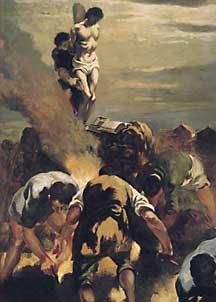
On October 27 (that's today), 1553 Michael Servetus was burned at the stake in Switzerland for denying that the Trinity was a scriptural concept and rejecting infant baptism. John Calvin thought he should be executed by sword rather than fire. He testified against him and urged the death penalty, only a gentle death penalty.

In this moment of weakness, William Farel admonished his brother in Christ to be bold and demand that Servetus be burned for the preservation of Calvin's faith. Certainly if, as Calvin taught, adulterers, witches, and disobedient children should be executed, then heretics deserved the most painful death imaginable. Farel wouldn't let Calvin budge and so Servetus was burned.

Do you sometimes feel squeamish about what the Lord requires of you? Are you ever confused about how to act? Don't cringe from encouragement and correction in the Body of Christ. Calvin was confused too. Providentially, Farel was there to sharpen him.

Are we sometimes divided over the details of our faith? Make sure you reach out to your brothers and sisters in Christ in those areas where we find common ground. We may not know how to kill God's enemies, but by His grace we know that they deserve to die. Whether we are on the receiving or giving end of encouragement and correction we can be united in purpose.

Lord, we ask that wherever Your Body may be divided we find unity. We ask that you look not on our sin, but in your mercy find us faithful for being willing to kill at all.

Monday, October 23, 2006

Defenestration is Fancy For "Toss Out a Window"


An Active Martyr Devotion
When we're killing for Christ it's important to remember it's not just the heathen that has to be killed. Oh it's important, but they're a steady outside threat that is easy enough to identify. When we need to round 'em up, we can easily spot them by their swarthiness, their funny hats, accents, or beards; and if it's too hard to spot them on the street, we can just wait until they gather to worship their false gods and collect them then.

Never forget, as dangerous as "they" are, there is a greater threat from the inside. Those who would claim to stand among us are a cancer in the Body of Christ. And like cancer, it often takes extreme measures to remove this threat. If we look to history as our example, we see there is as great a threat from those who would claim to be with us as there is from the outside.

We must be willing to examine our own communities and identify the Judas. Who is it that would threaten Christ from within our fold? That's a tough question, luckily we are surrounded by a great cloud of witnesses who possessed a great purity of vision and purpose.

Today's Active Martyr (that's what we'll call them) is Jan Zelivsky.

This Hussite preacher so loved the Lord and hated the corruption of the Church, he led his congregation to storm city hall and throw the city council from the upper windows and onto spears below.

Bold enough in itself, this move soon prompted the Hussite Wars wherein the Hussites were known to not take prisoners, preferring to shoot horses out from under mounted cavalry and then showering the heavily armored but immobile knights with musket fire in the streets.

They eventually got what they wanted: to celebrate with bread and wine.

Heavenly Father, give us a passion for your church. Let us act with boldness and zeal for the sake of Your Bride's purity.

Friday, October 20, 2006

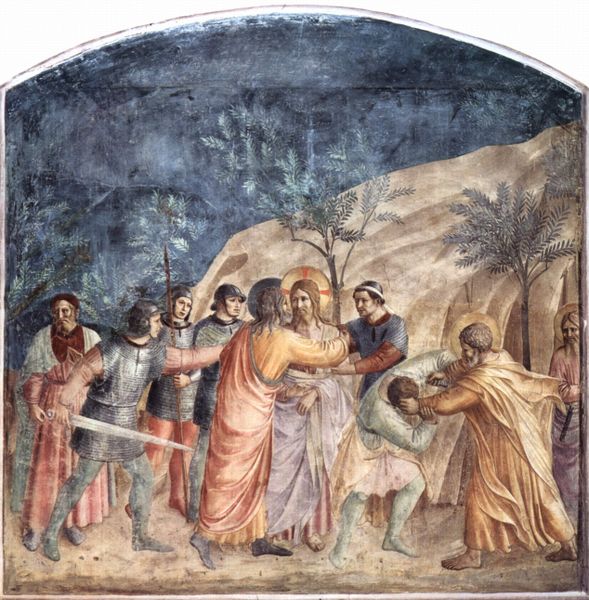
Peter in The Garden


"Even if I must die with you, I will not deny you."
And behold, one of those with Jesus stretched out his hand and drew his sword, and struck the slave of the high priest, and cut off his ear.

Maybe this is the zenith of Peter's career. We don't hear of him doing anything like this again, but whatever it was that subsequently stole his passion for Our Lord, we still have his early example.

He wasn't a soldier, or even an independent contractor trained in special interrogation techniques, still we see he was willing to do what he could- blooming where he was planted, if you will.

Maybe you're worried that you don't have anything to offer. You're not old enough to buy a gun; you're too little to beat anyone up; all you have is a lead pipe or a tube sock full of rocks. Look to Peter. In the face of superior numbers and weapons he did what he could. What can you do?

Dear Lord, when I feel small and overwhelmed, when I'm afraid and hemmed in by a great enemy, give me the courage to act.